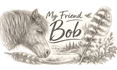

When we choose for another. A blog about love, responsibility and ethical euthanasia.

Sometimes you have to put your money where your mouth is.
Life demands that you live by the values you set yourself, rather than pay lip service to an ideology.
Be unapologetically authentic.
It means actually seeing something through, even when it is the most heartbreakingly difficult thing to do and you question yourself every step of the way.
I write in the context of equine companionship, but this equally applies to any animal under our stewardship and care. When we choose to take on a horse, we enter into a covenant, a soul contract.
We purchase/loan/lease our equine partners, knowing that they are dependent on us for everything relating to their health and welfare. We choose whether they get to live out 24/7; alone or with a companion or in a herd; what they eat and how often; how and when they are trained/worked/ridden….. Part of this partnership is a beautiful dance between two beings who seek connection and understanding and safety. Sometimes leading and sometimes being led, but invariably always learning about one another.
Our role as the human in this rather intriguing predator/prey partnership is to listen and to look for ways that make the partnership stronger, whether that’s a different style of training or tack, different forage, or a new discipline or adventure…..
I have personally found that the more I know about my own four-leggeds (and horses in general), the more I realise I don’t know. I have sadly never had a horse companion for long enough to have experienced a partnership into their twilight years, and perhaps one day in your partnership you finally nail everything there is to know about him or her? I do know that my five-year-old Dales X lad has given me plenty of opportunities to learn and made me curious enough to seek new and different ways of being with him over the past two-ish years that we have known each other for. To this day, he still presents me with new challenges and curiosities. Indeed, to be curious about him and how we work together best is a founding principle of my intention to always do right by my equine partner. I am not too proud or ashamed to admit that I don’t always get this right - when things go wrong, it’s all feedback (usually about myself more than my ponies’ response to what I did/didn’t do/asked!).
And so, if we are truly acting in the best interests of the horses and ponies we have chosen to steward and care for, what does this mean when life throws a curve ball, and shit really hits the metaphorical fan?
There are obviously clear-cut cases – when a horse has physical injuries or illness beyond our abilities to treat, then it’s a no brainer. But what about those caught in the in-between spaces. Where we can treat, but care might look like life-time medication that comes with its own set of unwanted circumstances?
Where a horse has been failed by humans and we create an animal no longer safe to interact with, and they become a risk to themselves and others? Where personal life challenges mean resources to properly care for them are scarce and the risk is a pony who becomes unintentionally neglected and/or a human stretched beyond coping with time/finances?
It is indeed a controversial and highly complex psychosocial topic, for which there won’t be one clear-cut answer either way. All I have (and can offer) is my personal opinion, now sadly coupled with lived experience.
A steward is someone entrusted with the care of something belonging to another. "The Lord God took the man and put him in the Garden of Eden to work it and take care of it." - Genesis 2:15. Humanity is given responsibility not only to use creation but also to care for and protect it. "The earth is the Lord's, and everything in it, the world, and all who live in it." - Psalm 24 24:1. This reminds us that we are caretakers rather than owners of the natural world….
You don’t necessarily have to have belief in God to understand the weight of these words. Even if you subscribe to a universal or source energy, more than one God, or indeed any other ideology that there is a higher power within and all around us, then the importance of stewardship of all of nature, including our own four-leggeds, is something you fundamentally understand and live by.
Indeed, there are some beautiful traditions from both Western and Indigenous cultures that speak about our relationship with horses as one of partnership rather than ownership. Many Indigenous peoples of North America regard the horse as a relative, teacher, or partner rather than simply livestock. While beliefs vary between Nations, a common theme is that horses are gifts that carry humans physically, emotionally, and spiritually, creating an obligation of respect and care in return. "The horse lends us its strength, its trust, and its freedom. In return, we owe it our respect, our protection, and our gratitude." Similarly, among some Plains cultures, horsemanship was traditionally understood as a relationship built on mutual trust rather than dominance. And in the words of the British writer and naturalist Henry Beston, "In a world older and more complete than ours, they move finished and complete, gifted with extensions of the senses we have lost or never attained..."
Horses have carried humanity for thousands of years. They have helped us travel, farm, explore, compete, heal and connect with nature. Whether we view them as partners, teachers, companions or simply fellow living beings, their contribution creates a responsibility in return: to understand their needs, respect their welfare, and ensure that the relationship benefits them as much as it benefits us.
When we are genuinely called to make a decision on the future welfare of our equine companions, consideration has to be given to the best interests of the horse and the horse population in general. This might mean making a decision that feels horrific but satisfies the conditions of being a good and faithful steward rather than appeasing personal and social conscience. I have been here. And I still stand by the saying “there is a fate worse than death”.
In a country where rescue centres are busting at the seams, and the marketplace is flooded with people looking for homes for their four-leggeds for a millions different reasons; and in a situation where I can do my absolute best to find a loving forever home, but actually cannot give my pony any promises that his safety, welfare and wellbeing is 100% guaranteed for the remainder of his life, what can I do as a companion, partner, steward, protector? There is only one answer.
It’s gut-wrenching and heartbreaking and uncomfortable and calls to question everything I know and believe. But the pain I feel at making such an agonising decision is my burden to bear. The price for choosing to be a guardian for another living, sentient being, who thus far (in his time with me) has known nothing but understanding, safety, respect, connection, and dare I say, love…..At the point I can no longer steward him as well as he deserves (for he had no choice in becoming my companion), the last thing I can offer him is the dignity of departure from a life that knew nothing of pain and neglect. It’s highly emotive, incredibly controversial, and everybody has the right to make up their own mind about what is and isn’t best for the horse...
The measure of our relationship with nature is not what we take from it, but how we care for it. Horses have walked beside humanity throughout history. They have carried our burdens, shared our adventures, supported our wellbeing and enriched our lives. Their trust is not something we earn once, but something we are called to earn every day.
Stewardship is not about ownership. It is about responsibility. It asks us to consider what we owe to our animals. In caring well for horses, we are reminded that our place in nature is not above it, but within it.
This text is written and offered as my opinion based on my own personal values, beliefs, and experience. Should you ever find yourself in the situation of having to make the decision for your own four-legged, and if ethical euthanasia is a consideration, I hope that you find some comfort in these words.
To my dearest Cowgirl
I saw your heart break today
Into a million pieces
I already know you love your people deep and hard
Today it was not two legs, but four,
That ran through a field full of stars
And took part of you with him
Add comment
Comments